

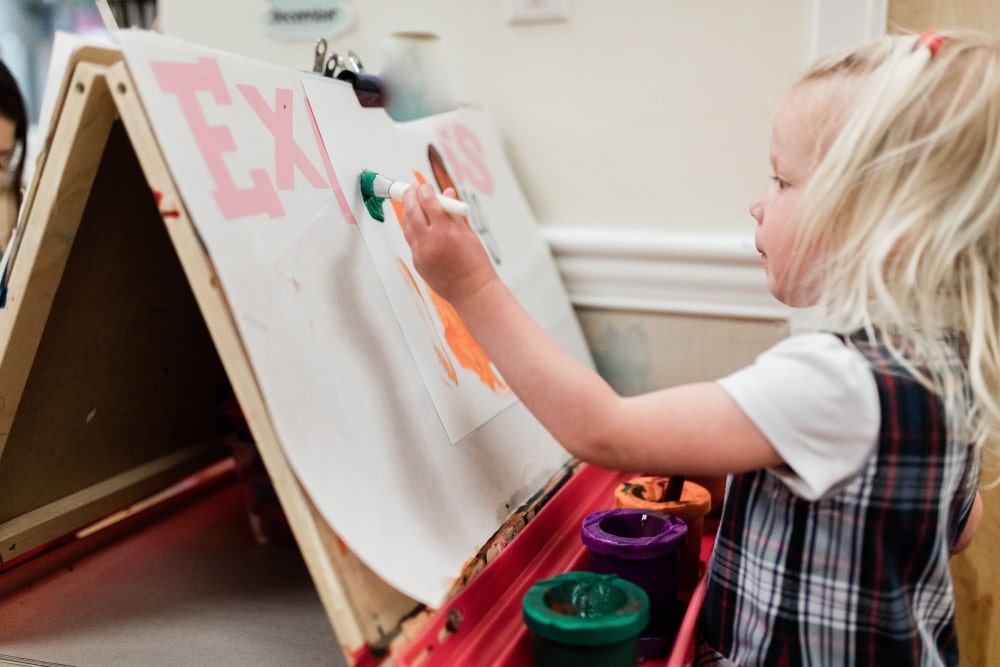
Children have many different ways of expressing themselves—their movements, language, and imagination, to name a few. One that gives us a window into their creativity is their artwork. As a parent, you know the joy of seeing what your child created at school and how proud they are of their masterpiece. Artistic expression is an opportunity for us to support the creative development of our young learners. It’s also a key component of a S.T.E.A.M.-based educational approach (Science, Technology, Engineering, Art, and Math). While a traditional S.T.E.M.-style approach teaches the building blocks of science, technology, engineering, and math, adding art into the equation helps children develop a multidisciplinary approach to learning. To help you encourage your little artist, we’ve shared five ways to support your child’s art.
1. Display Their Work Proudly
There is no better support than showing your child how much you love their artwork. Imagine their joy when you display what they’ve made on the fridge, the mantle, or the wall. You can even get creative with your display. Dedicate a part of the house or a wall to allow your child to decorate with their art however they please. Make a point to show your visitors what beautiful artworks you now have displayed around your house and let your child hear the praise, or tell them what your friend, coworker, or loved ones liked most about the piece.
2. Create an Art Corner
With a craft corner, when the mood to create strikes, your child can express themselves with their craftiness whenever they’d like. Set up a small desk or table and surround it with supplies: paper, coloring pencils, markers, paint, glue, child-safe scissors, and even household or found items. You might even enlist your child in helping to put their corner together just how they like it, contributing to their feeling of ownership and independence.
3. Visit an Art Museum
Ready for an adventure? Take your child to an art museum. No matter how big or small the museum, you can make a learning experience out of it. Ask them to point out the colors in the artworks they like most, or how they would describe their favorite pieces. What shapes is the artist using? What details does your child notice if looking close up? These conversations can help your child explore their feelings about art and build an important foundation for his or her future work.
4. Find Local Art in Your City
Your city likely has art all around. With the prevalence of murals and other street-art installations, you and your child can spend the day spotting the vibrant art additions to your city. This is another opportunity to ask your little one questions about how they feel about the art, what they like or dislike about it, and how they would describe it. Or is there a special art walk or exhibition in a retail shop or other community building? You’d be surprised how much you’ll find around your city that you may have not even noticed before!
5. Talk About Their Art
Last but not least, talk about your child’s art. Their creative expression is a window into their thoughts and feelings, and it’s a chance for you to talk through their creative process, asking them how they felt when they made it, what they love about it, and what they’re excited to create next. These discussions show your child that you support their creative outlets and that you’re excited to see how they progress.
The Gardner School Fosters Creativity
Creativity and imagination are two of the most vital elements of early childhood education. Children learn through this play and expression, and The Gardner School is excited to foster that creativity and support your child’s art, allowing them to become the person they were meant to be. Curious to learn more about The Gardner School’s educational philosophy? Contact us to schedule a virtual or in-person tour!